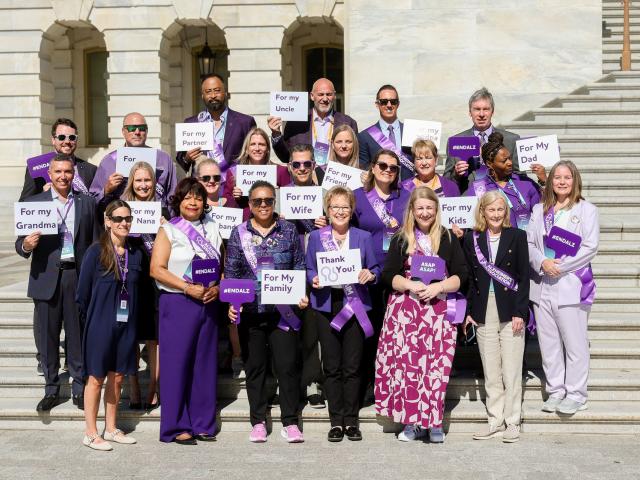
Bipartisan Alzheimer’s Screening and Prevention (ASAP) Act moves another step forward
WASHINGTON, D.C., Sept. 16, 2026 — The Alzheimer’s Association and the Alzheimer’s Impact Movement (AIM) commended the House Ways and Means Committee today for voting to advance the bipartisan Alzheimer’s Screening and Prevention (ASAP) Act. This vote marked the bill’s second major step forward in the House this week, advancing legislation that would clear the legal barrier keeping Medicare from covering early Alzheimer’s detection tests.
“Every step this bill takes forward is a step closer to families getting answers when it matters most,” said Robert Egge, Alzheimer’s Association chief public policy officer and AIM president. “This kind of bipartisan progress doesn’t happen on its own, and we’re grateful to Chairman Smith, Ranking Member Neal and the bill’s congressional champions for continuing to move it forward.”
Many members of the committee spoke out in support of the bill, including Rep. Jason Smith (R-Mo.), Rep. Vern Buchanan (R-Fla.), Rep. Linda Sánchez (D-Calif.), Rep. Darin LaHood (R-Ill.), Rep. Don Beyer (D-Va.), Rep. Brad Schneider (D-Ill.), Rep. David Kustoff (R-Tenn.), Rep. Gwen Moore (D-WI) and Rep. Rudy Yakym (R-Ind.), many sharing their own personal experiences and that of their constituents.
“More than 7 million Americans are living with Alzheimer’s disease, and for too many families, a diagnosis comes only after the disease has already taken a serious toll,” said Rep. Jason Smith, R-Mo., chairman of the House Ways and Means Committee “New cutting-edge blood tests will help detect Alzheimer’s years before symptoms appear. But Medicare rules stand between seniors and access to these tools.”
“My father, at 58, found out he had Alzheimer’s. We worked through that together, and it’s just really important what we’re doing here, and the idea of prevention is key,” said Buchanan. “Blood-based biomarker tests are transforming what is possible with Alzheimer’s. Our goal is simple: catch the disease early, treat it sooner, and give families more time with their loved ones. With over 200 bipartisan co-sponsors and support from 525 organizations, this legislation shows strong bipartisan backing and significant momentum toward addressing a shared national priority.”
“Many folks here know that I lost both of my parents to Alzheimer’s,” said Sánchez. “The earlier we can detect any sort of dementia or decline in cognitive reasoning, the earlier families and their providers can determine an appropriate care plan and put that into place.”
Medicare is legally barred from covering screening tests for diseases that cause dementia, but Congress can change that. The ASAP Act would fix it the same way the MCED Act did for cancer screening — authorizing coverage through Medicare’s own evidence-based process, not a new mandate.
More than 9 in 10 Americans say they would want a simple blood test for Alzheimer’s if one were available. A national survey of registered voters found that support translates directly into policy demand: 90% support Medicare covering FDA-cleared Alzheimer’s blood tests, with just 2% opposed, and 88% back the ASAP Act specifically.
“Advocates across the country have spent this year showing up in congressional offices and at town halls to make sure lawmakers understand what earlier detection means for their families, and today’s vote is proof that message is being heard,” said Rachel Conant, Alzheimer’s Association senior vice president of public policy and AIM executive director. “This legislation matters enormously to the Alzheimer’s community, and we’re going to keep working until the ASAP Act reaches the president’s desk.”
Today, the ASAP Act has 217 bipartisan cosponsors in the House and 50 in the Senate. The bill was introduced in the House by Reps. Vern Buchanan (R-Fla.) and Paul Tonko (D-N.Y.), and in the Senate by Sens. Susan Collins (R-Maine) and Catherine Cortez Masto (D-Nev.).