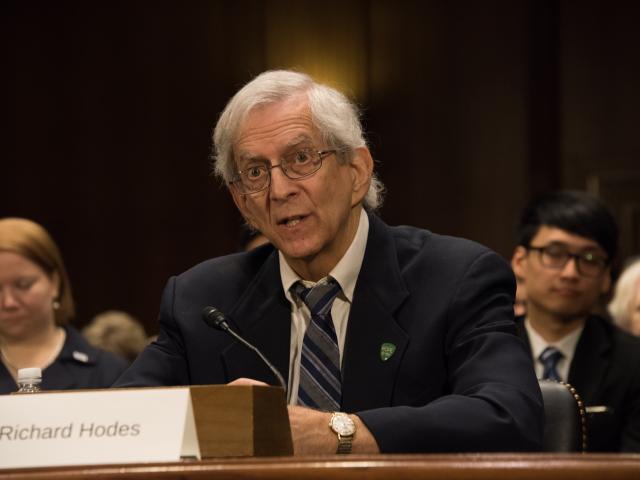
As Richard J. Hodes, M.D., prepares to retire as director of the National Institute on Aging (NIA), the Alzheimer’s Association® joins people living with Alzheimer’s and other dementia and their families in thanking him. Discoveries made during his tenure have already improved lives, and will for years to come.
Hodes has led NIA since 1993, a tenure that spans a historic period in Alzheimer’s and dementia research. In that time, scientists have made biomarker discoveries, developed new diagnostics, gained a deeper understanding of the biology of the disease, advanced treatments and learned more about risk and risk reduction.
“Dr. Hodes led the NIA through the most consequential era in the history of Alzheimer’s and dementia research, and the Alzheimer’s Association was proud to work alongside him,” said Joanne Pike, DrPH, president and CEO of the Alzheimer’s Association. “His partnership helped change what is possible for people living with dementia, their care partners and their families. Thank you, Dr. Hodes. The next era is even more hopeful and we look forward to building on your legacy of leadership and discovery.”
When the National Alzheimer’s Project Act (NAPA), championed by the Alzheimer’s Association and the Alzheimer’s Impact Movement (AIM), passed in 2011, Hodes led expansion of NIA’s Alzheimer’s and related dementias research initiatives. He oversaw historic growth in Alzheimer’s and dementia research funding appropriated by Congress, which reached more than $3.9 billion annually in 2026. In 2020, he partnered with the National Institute of Neurological Disorders and Stroke to launch the NIH Center for Alzheimer’s and Related Dementias.
“Dr. Hodes was an essential partner to the scientific community as biomarkers moved from the lab toward the clinic, diagnostics advanced, treatments reached people and our understanding of the biology of Alzheimer’s and of risk and risk reduction grew,” said Maria Carrillo, Ph.D., chief science officer and medical affairs lead of the Alzheimer’s Association. “The science has never been more promising. We will keep driving it forward with the NIA and researchers around the world.”